
dbx 231s
The workhorse solid-state 31-band graphic EQ found in touring racks and studios worldwide, valued for precise, no-nonsense frequency control rather than character.
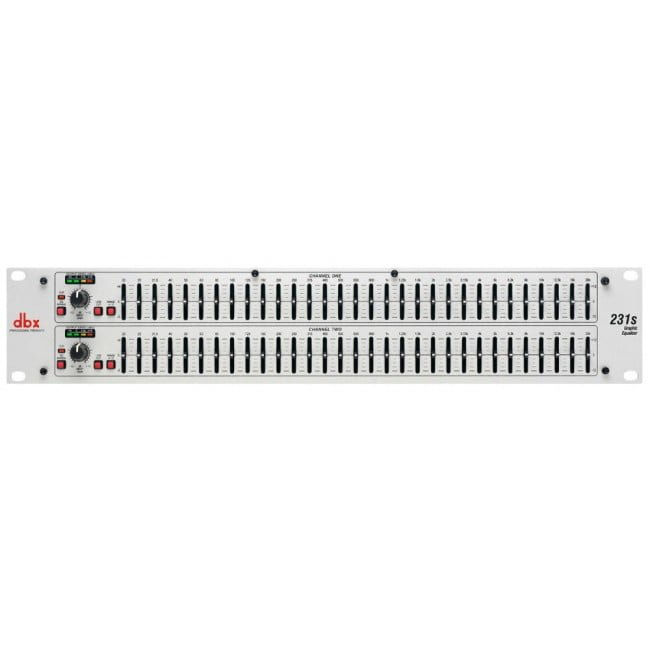
dbx
2011
Equaliser
Graphic
$249–$299
Key specs:
Type | Active solid-state, dual-channel, 31-band, 1/3-octave constant-Q graphic equalizer, with switchable ±6 dB or ±12 dB boost/cut range and a 50 Hz, 12 dB/octave low-cut filter |
Frequency response | <10 Hz to >50 kHz, +0.5/-3 dB (system bandwidth 20 Hz–20 kHz, +0.5/-1 dB) |
Distortion | <0.003% THD+Noise |
Noise | Signal-to-noise typically >95 dB; dynamic range typically >112 dB |
Input impedance | Balanced 40 kΩ, unbalanced 20 kΩ |
Output impedance | Balanced 100 Ω, unbalanced 50 Ω |
Connectors | 1/4" TRS and XLR (input and output) |
Chassis | 19" rackmount, 2U, 6.2 lbs (2.81 kg); external power 100–240VAC, 15W via IEC connector |
About
The dbx 231s comes from a company whose reputation was built somewhere else entirely. Founded in Boston in 1971 by David Blackmer, a Navy veteran and Harvard/MIT-trained engineer, dbx made its name first with noise reduction (a companding system that competed directly with Dolby through the 1970s) and then with the dbx 160, released in 1976, one of the first commercially successful compressors built around a voltage-controlled amplifier. Graphic equalizers came later, but dbx's own product literature traces the 231s's lineage back to its 12 and 20 Series graphic EQs, some of which, like the dbx 20/20, doubled as real-time spectrum analyzers and were considered genuinely advanced for their era.
Where the Pultec EQP-1A shapes sound with two broad, musical bands and lets the passive circuit's imperfections become part of the character, the 231s takes the opposite approach entirely: 31 individually adjustable bands per channel, spaced in 1/3-octave steps across the entire audible spectrum, each one boosting or cutting only the narrow slice of frequency it's centered on.* That's a fundamentally different design philosophy, less about adding color and more about precise, surgical correction, which is why a graphic EQ like this one is far more common in sound reinforcement and room correction than in a mix bus chased for its own sonic signature.
The "S Series" revision this entry covers, introduced in 2011, refined the electronics for lower noise over the original 2 Series 231, while keeping the same fundamental 31-band layout, switchable boost/cut range, and rugged rackmount build dbx is known for. It remains in production largely unchanged today, a testament to how well-suited the format is to its job.
Notable for: One of the most widely used 31-band graphic equalizers in professional audio, a fixture in touring sound racks, installed venue systems, and studio monitor chains for its combination of precision, reliability, and low cost relative to boutique alternatives.
Applications
Examples: Live sound system tuning, monitor wedge feedback control, room correction and acoustic treatment, mastering-chain or mix bus tonal correction, and general-purpose broadband EQ work.
Live sound reinforcement is the 231s's core habitat. Front-of-house and monitor engineers use its 31 narrow bands to notch out specific frequencies causing feedback in a monitor wedge or a PA system, a task that's difficult to do precisely with only two or three broad bands, since a graphic EQ lets an engineer target the exact problem frequency without collaterally affecting the rest of the mix's tone.
Room correction and acoustic treatment lean on the same precision: placed across a monitoring system or a venue's main PA, the 231s can compensate for resonances and dips caused by room dimensions and speaker placement, evening out the frequency response a listener actually hears rather than what the source material contains.
In the studio, it's less commonly used as a creative mixing tool (that role tends to go to something like the Pultec, precisely because the 231s doesn't have much character to offer) but sees regular use for corrective, surgical work: cleaning up a problematic recording, taming a specific resonant frequency, or acting as a broadband tone control on a mastering or mix bus chain where transparency matters more than color.
Its low cost, rugged build, and dual-channel design also make it a common choice for stereo program material generally, anywhere two matched channels of precise, narrow-band control are needed without the expense of a boutique or channel-strip-integrated EQ.
*Glossaery - In plain terms:
"1/3-octave" describes how closely spaced the 31 bands are, each one covers a third of a musical octave, which is narrow enough to target a specific problem frequency (like a ringing monitor wedge or a boomy room mode) without disturbing the frequencies around it. "Constant-Q" means each band keeps that same narrow width whether you're boosting it a little or a lot, rather than getting wider or narrower depending on how far you push it, which makes the EQ's behavior more predictable to work with.